Once your trophies leave the skinning shed, they are out of your sight. In the stages that follow they are dipped, tanned, mounted and crated. It is fair to wonder whether the animal that comes back is the one that lay at your feet in the veld.
Ask around among first-time safari hunters and the same question comes up: how can I be sure the skins and horns that arrive are my own animals? The advice they give one another is to photograph distinctive markings, zebra above all, before handing anything over. One account describes a zebra skin arriving that did not match the hunter’s own field photographs.
It is a reasonable question, and we would ask it too. A hide with no name on it looks very much like the next hide with no name on it, and a folded cape does not announce whose it is. So the honest answer to “how do you know” cannot be “trust us”; it has to be something you can check for yourself. Ours has two halves: a number that never leaves your trophy, and a photo portal that lets you watch it.
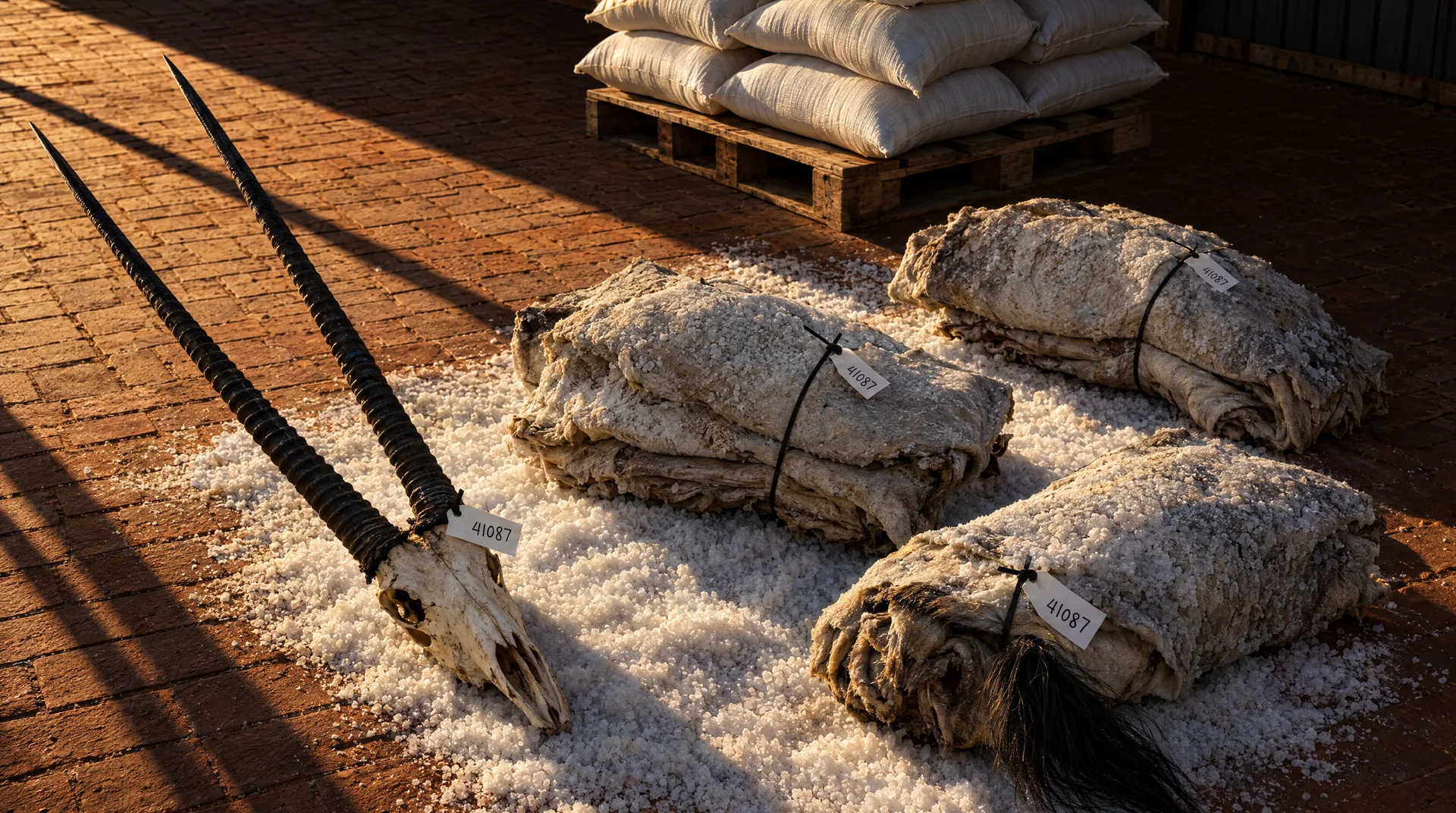
When your trophies reach our studio in Erasmia, our production system assigns them a five-digit job number. That number is your project number, and it goes onto a tag attached to each horn, each hide and each skull. Every hide carries two tags. The horns, the hide and the skull of one animal are tied together by the same five digits from the start.
The tag is chemical-resistant. That matters more than it sounds, because it has to go through the dip and the tannery and still be on the item when your crate is opened at home.
Intake is also where the photographic record starts. Each skull is photographed from two angles. Skins arrive folded and dried, so each one is photographed on arrival to record the condition it came in.
Even within one studio a trophy passes through several hands: the dip, the tannery, the mounting floor or the packing bench, and finally the crate. Each of those is a place where an identity could go missing. Ours lives on the item.
Your hide goes into the dip with two tags on it and comes out with two tags on it. It goes through our in-house tannery the same way, and because the tannery is under our own roof, your hide is tanned by the same team that tagged it.
The number stays on through mounting too. Nothing waits on your choice of shoulder, pedestal, skull or full mount; the number is already on the cape while you are still measuring your wall. Whether your trophies are booked for full mounting or for dip-and-pack to a taxidermist at home, the tags stay put.
Crating is the last stage. It is done by our sister company, Oxi Logistics, who build the crates and handle the export paperwork. The tags go into that crate still attached, and the first hands to take them off are yours.
Our tags begin at our door. Before that, the best identity record is your own, made in the field with your own camera or phone. Our field care guide covers photographing your animal for colouring and pose; these are a different set of photographs, taken for identification only.
Photograph whatever only that animal has. On a zebra that means the stripe pattern. On horned game it is the horns themselves, and anything else you would recognise again.
Keep those photographs somewhere easy to find once your hunt is over. When the first portal photographs go up, the two belong side by side on your screen. A stripe pattern set beside a stripe pattern is a better answer than a promise from anyone, ourselves included.
Every client receives a login to our photo portal at photos.highveld.biz. Each job has its own gallery, in date order, and every photograph in it can be downloaded and commented on.
The first photographs go up as soon as your skins are hydrated, so every one of your hides is there to see. From there we upload regular photographs so you can follow the process from home.
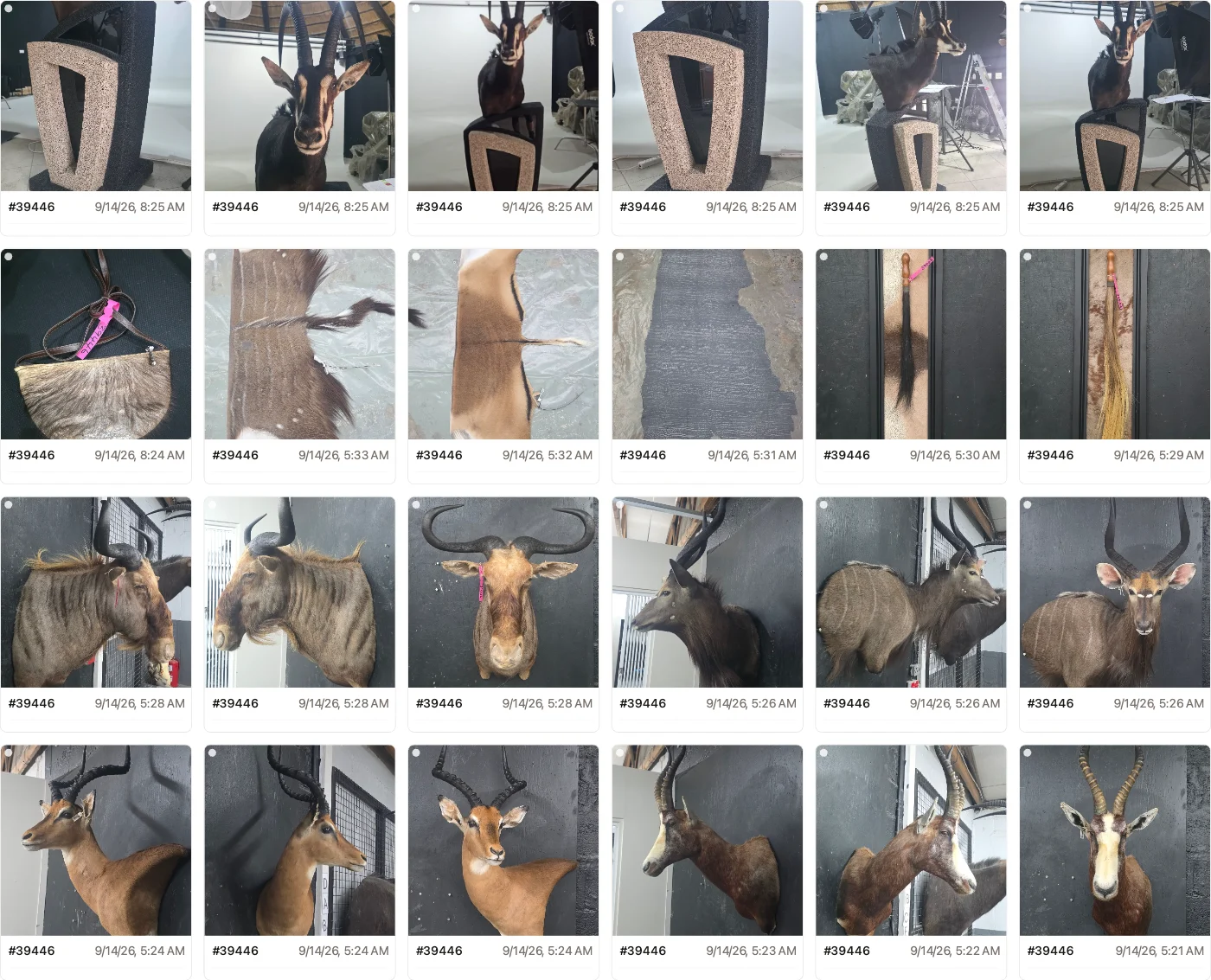
You do not have to keep checking. An email reaches your inbox when new photographs land, and each update notifies your outfitter as well as you. The person who stood beside you in the field can see what came out of the shed.
The upgraded portal launched in April 2026, and the archive behind it holds more than 220,000 photographs. Your gallery is one small corner of it, under a number that belongs to nobody else.
Say so, straight away, and say it on the photograph itself: a comment in your portal is attached to the exact image you are querying, so nobody has to guess which animal you mean. If you would rather write, email our office and you will get an immediate response. Nobody here minds being asked; that is exactly what commenting is for.
The intake photographs are there from the start: each skull from two angles, each skin as it arrived, folded and dried. We would far rather hear a doubt while your trophies are with us than a certainty after the crate is open.
None of these is a trick question. They are simply what we would want to know if the trophies were ours.
Our answers are the sections above, and you should have yours before you hand anything over, not after.
Three questions about identity and the portal.
The first photographs go up as soon as your skins are hydrated, so you can see each and every hide. From there, regular photographs follow so the process can be watched from home, and an email lands in your inbox when new photographs go up.
Yes, outfitters and professional hunters have their own view of the jobs they referred to us. Every update to your job notifies your outfitter as well as you, and they also receive a regular digest of all movements on their clients’ orders, with links to the photographs.
Yes, dip-and-pack-only clients receive portal access too. You receive a login and a gallery like any other client, and the tags on your horns, hide and skull are the same tags, still attached when you open the crate at home.
We are a family studio, founded in 1981 and still working from Erasmia near Centurion, outside Pretoria. The answer to the question at the top of this post is not a promise. It is a five-digit number on a tag that goes on before anything else happens and comes off in your own hands, with photographs along the way so you can watch it happen.
Wherever home is, the first step is a conversation. Our client-liaison office in Charlotte, North Carolina, supports our US clients, and all the taxidermy work is done at the South African studio. Tell us what came out of the skinning shed and where your trophies are headed, and we will take it from there. Start your project with Highveld Taxidermists.