Before most safaris, American hunters ask us the same question. Should your trophies go home to a taxidermist you know, or should the work be finished here in South Africa? If you are still weighing that up, start with the three routes compared.
There are good and bad taxidermists all over the world, so this guide is about timing, not quality. Whoever you choose, look at a studio’s finished work for yourself before you leave your trophies with them. Tanning before export is a service we sell, so weigh what follows with that in mind. The numbers are the ones we see, and every figure below counts from the day of your hunt.
If your skins are shipped home raw, it is usually ten to eighteen months after your hunt before your taxidermist has tanned skins to work on. If we tan them here first, it is usually four to five months. Those are typical figures for most plains game tanned hair on. Leather-tanned skins take approximately seven to eight months from your hunt.
Here are the two routes side by side, counted from your hunt, if your taxidermist’s own turnaround is six months.
CITES-listed species can take longer on either route. If you have the work done in South Africa instead, we quote a timeline for your own trophy list.
Almost the whole difference comes down to one stage, the tanning step on the US side, and the sections below explain each step.
In our experience, four to six months from your hunt, depending on the export permits your animals need and whether any CITES-listed species are in your order. CITES is the international permit system for listed species.
The dipping and crating processes are the quick part. Most of the wait is export paperwork, which we prepare with our sister company, Oxi Logistics, and it moves at the pace of the permits. Our guide explains what dip and pack involves.
Crates of skins to the US usually travel by air, so the flight is not where the delay comes in. Our guide to international trophy shipping covers the journey itself.
They go to a commercial tannery before your taxidermist can start, because most US taxidermists send their tanning out rather than doing it in-house. Your taxidermist either sends the skins in for you or has the crate consigned straight to the tannery.
From what our clients tell us, that tanning step on the US side, from landing to tanned skins back with your taxidermist, commonly takes six to twelve months. Many US tanneries have closed in recent years, and the ones that remain carry a great deal of work, which builds up after the hunting seasons.
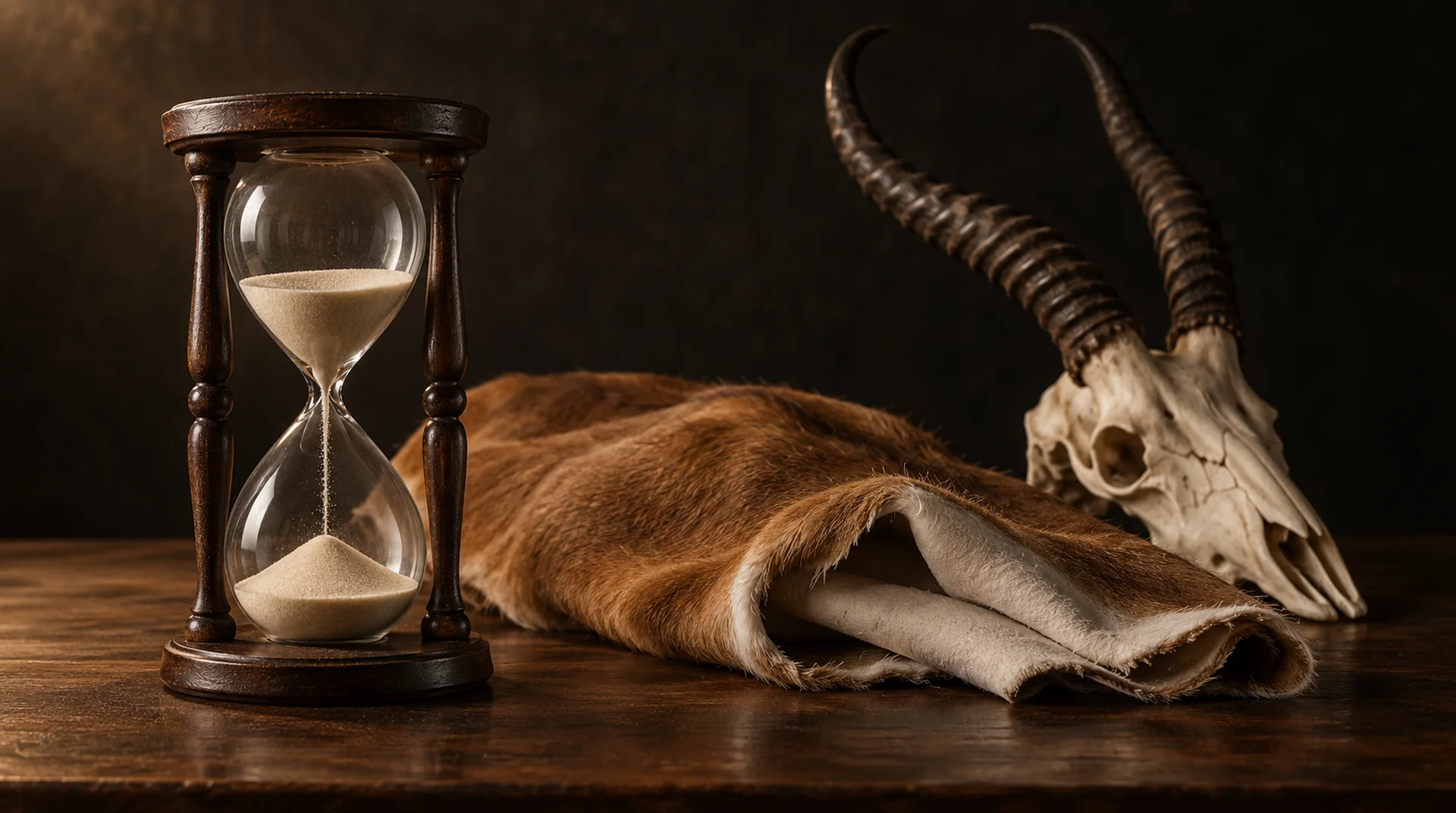
Not every taxidermist faces that wait. Some tan in-house and avoid this extra delay, so ask yours what their tannery is quoting today. To see what this extra delay means for your skins, see what a long wait can do to a raw hide.
Usually not, because a quoted turnaround normally starts when tanned skins reach the studio, so it leaves out the months of export paperwork and the US tanning step.
That is ordinary practice across the trade. A taxidermist quotes the part of the job they control, and the permits and the tannery sit outside it. Your clock starts on the day of your hunt, while theirs usually starts when tanned skins reach their bench.
Say your taxidermist quotes six months. That figure covers their own work, as it is meant to. Add the stages that come before it, and on the raw route your mount reaches the wall sixteen to twenty-four months after your hunt. If the skins arrive already tanned, the same six months on the bench usually puts it at ten to eleven months after your hunt for most plains game.
It is the part of the calendar most hunters do not know about, because each stage is quoted on its own. So have the conversation with your taxidermist before you hunt. Ask for a date counted from the hunt rather than from the day the crate arrives.
We can tan your skins at our own tannery in South Africa and send them to your taxidermist already tanned and ready to work on, so they skip the US tanning step entirely. For most plains game, they usually reach your taxidermist four to five months after your hunt. That is at least five months sooner than on the raw route.
Tanned skins still need their export permits, including CITES where it applies, and still clear US Fish & Wildlife on arrival. What they skip is the US tannery. Your taxidermist’s own quoted delay time still applies, so book their slot for the arrival date.
You can book our tanning service up to two weeks after your skins reach our studio, and the earlier you tell us, the better. We are glad to talk to your taxidermist directly about how the skins arrive and the process that we use. Our tannery guide explains how our tannery works, from recipes developed with BASF and Stahl to every hide shaved by hand.
If we tan your skins, you get a status report as soon as they are rehydrated and photographed at our studio, before anything is tanned or crated. If they are shipped raw, damage that develops after the crate leaves us usually comes to light at the other end, once the skins are opened for tanning, many months after your hunt and once you have paid for the transport and preparation.
Those first photographs go up in your photo portal once the skins are hydrated, so you can look at each hide yourself.
Damage that starts in the field cannot be undone by anyone, and if the bacterial damage is too severe, we can source a replacement hide for you. If we tan the skin, you find out early, with photographs of the skin so you can see the condition. This gives you time to arrange a replacement with us before a non-viable skin travels halfway around the world. If you are unsure what hair slip is, our tannery guide covers it.
A few plain questions to ask your taxidermist before you hunt can give you much more certainty on the timeline for your trophy completion.
That is your taxidermist’s decision, so ask them before you book your hunt. We are glad to speak to them directly about how the skins are prepared, packed and shipped. If it helps, ask your taxidermist to call or email us. We tan for many US taxidermists and can supply references with pleasure.
Ideally, this choice should be made after the hunt and not more than two weeks after the skins have arrived at our studio. The earlier we can start the tanning process, the better the quality of the hides. It helps to tell us as early as you can, and to let your taxidermist know at the same time that your skins will arrive already tanned.
The date your trophies go on the wall is mostly decided before the first shot, by the route you choose. Your taxidermist’s skill decides how the mounts look, and the route decides when the skins reach their bench.
If you plan to mount at home, speak to your taxidermist and talk to us before you travel. Our client-liaison office in Charlotte, North Carolina, can take you through it, and all the work itself is done at our studio in South Africa. If tanning in South Africa first suits your plans, our services page covers tanning in South Africa.