This decision gets made early in the process and is, unfortunately, not reversible. As the animal gets to the skinning shed, you need to give the instruction for which type of mount it should be prepared for.
After 45 years of mounting African game, here is some practical advice that will save you a lot of headaches and disappointment:
If your plans are still open, the safest instruction is also the most generous one. Ask for the animal to be caped for a full body mount.
A full-body cape can still become a shoulder mount or a pedestal mount later. The back hide can be tanned separately. It keeps the feet as well, which can be made into furniture or a base. Nothing is lost by caping long. A great deal is lost by caping short.
Most professional outfitters already skin further back than a shoulder mount needs — usually halfway between the front and back legs. That quietly keeps a pedestal on the table without anyone having to ask. It is still worth saying out loud before the hunt rather than assuming.
There is one thing that long cut can’t give you. A flat rug is cut differently, along the belly and all the way to the bottom lip, and that seam would run straight down the front of any wall mount. So if a rug is on your list, it has to be decided in the field. Our guide to field care in the first 24 hours covers what else to raise with your PH before the hunt.
The head, neck and shoulders, sitting flush against a wall. It is the most common treatment for African plains game, and the one most people picture when thinking of taxidermy.
What surprises clients isn’t the height. It’s the projection. A kudu shoulder mount runs about 65 in (1.65 m) from the bottom of the brisket to the horn tips, and stands 35 in (0.9 m) out from the wall. In your corridor, above your stairwell or beside a doorway, that is a great deal more object than most people expect.
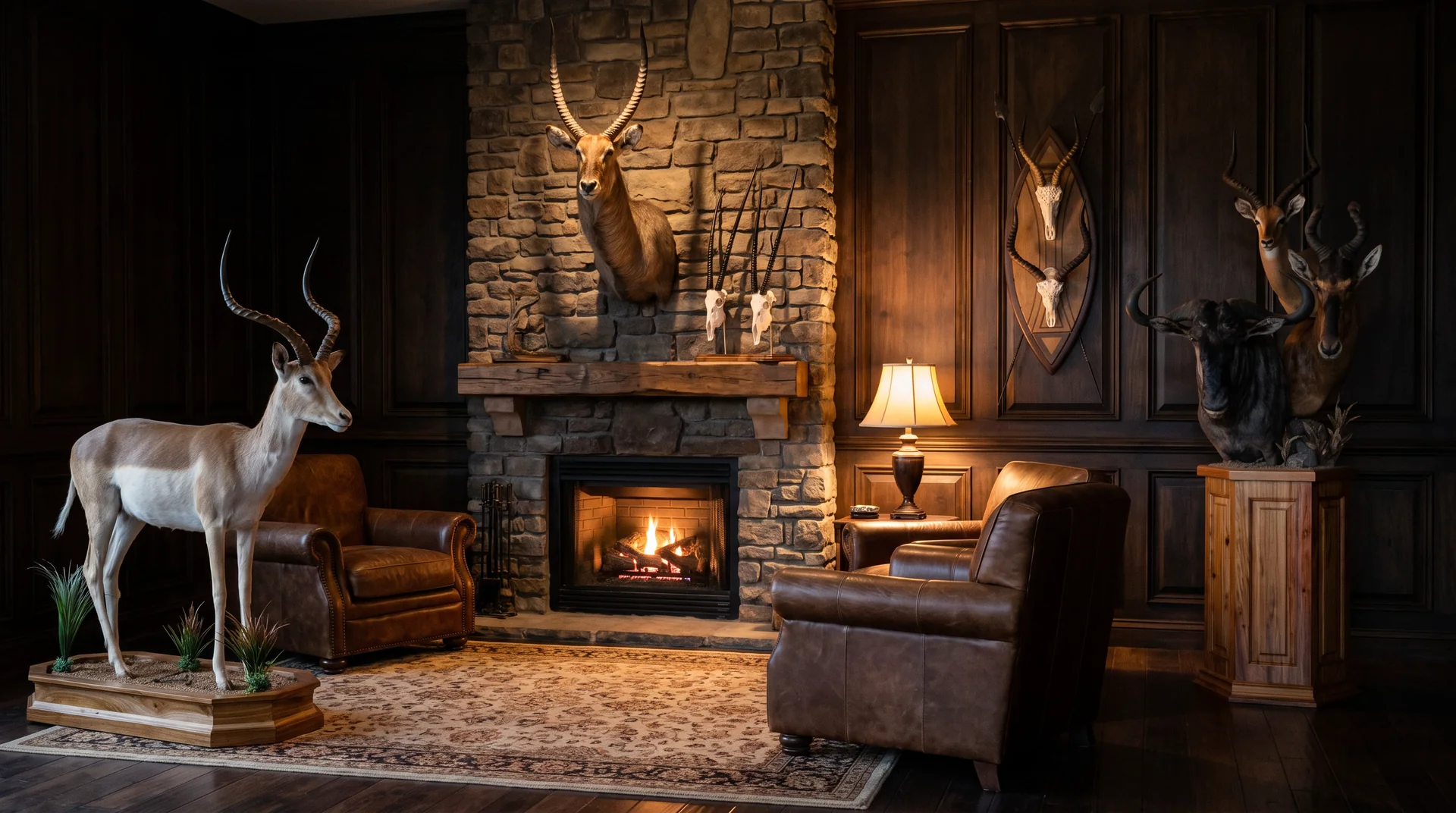
A shoulder mount works well for all African game and there is a wide variety of poses and variations of shoulder mounts we can offer to decorate any room. Have a look at our shoulder mount gallery.
This type of mount features more of the animal’s shoulder and body, with the head turned into the room rather than pointing straight out of the wall. It can stand on the floor, or be fixed to the wall.
A kudu floor pedestal needs roughly a 3 ft by 3 ft (0.9 m square) footprint and 7.5 to 8 ft (2.3 to 2.4 m) of height. So it is a floor space decision rather than a wall decision, which is often exactly why it suits a room where your walls are already full (or a room that has too many windows). Measure your ceiling before you commit. At the top of that range a pedestal will not clear a standard room height, which is the one dimension nobody checks until the crate is open.
It shows the turn of the neck and the sweep of the horns in a way a flat wall mount simply can’t. What it needs is a longer cape, and floor space — usually easier to spare than another clear wall. There are examples in our pedestal mount gallery.
The cleaned skull and horns, with no cape at all. American hunters generally call it a European mount and South Africans generally call it a skull mount. They are the same thing.
It is the least demanding treatment in every direction: least wall, least volume in the crate, least commitment. That makes it the sensible home for a trophy that pleased you without being the animal your room is built around.
It is also where skull art starts. A plain skull can become something else entirely — deep three-dimensional carving, scrimshaw, beadwork, electroplating, painting. Each is a one-off rather than a standard finish, and the results land somewhere between a trophy and a piece of art. Plain and decorated skulls are both in our skull mount gallery.
The whole animal, standing, walking, or set in a habitat. It requires the most space, but really puts the focus on the animal. Some trophies are best shown off as shoulder or pedestal mounts, as the rest of the hide is unremarkable, but certain animals need to be full body mounts to show off their stunning markings — a nyala or bushbuck, or any cat mount for that matter.
What matters at the field stage is that caping for a full mount commits you to nothing. Cape it long. Get your trophies home, then decide once your room is in front of you. Our full mount gallery gives a sense of the scale involved.
We call it a Zulu mount. Really it is a pedestal mount presented on a hand-carved wooden shield shaped to mimic a traditional Zulu cured-hide warrior shield.
The shield can be made to hang on a wall, or to stand on the floor on a double-tier base cut in the shape of the African continent. It is a versatile platform. One shield can carry a single or multiple pedestal mounts, or several skull mounts arranged together.
Because every shield is carved and styled individually, no two are alike. It suits a room that isn’t a dedicated trophy room, which is part of why our clients love it. The Zulu mount gallery shows the carving up close.
Turn direction decides where in a room a trophy can live. It is also the detail most often left to chance.
We always describe the turn from the animal’s point of view. A 45-degree right turn means the animal is looking to its own right, which is your left as you stand in front of it.
That works well at the right-hand end of a wall, where it brings the animal’s eye round into the room. On the dead centre of a long, straight wall it does the opposite and sends the gaze off into a corner.
Our rule of thumb is simple: the animal should look into the centre of the room from wherever it is placed. Tell us where in your room a mount is going and we’ll set the turn to suit the position. A pair mounted to face one another is a deliberate choice, and adds a great touch to a trophy room. This is why we have a detailed consultation once you are back home and can show us the space intended for the display of the various trophies. We then custom sculpt the poses to best work with your intended display area.
There is no wrong answer by species. Almost every plains-game animal works in almost every treatment. But two patterns are worth knowing before your decision is final.
The first is trophy size, and it is the regret we see most often. A hunter takes a modest trophy on a first safari and has it done as a shoulder or pedestal mount. By the third or fourth trip, the best wall space is occupied by the smallest trophies in the collection. Nobody comes to Africa only once (even if that was your initial intention). If a trophy is on the smaller side, a skull mount honours it — and keeps space open for what follows.
The second is sets. Mounts look better in considered groups rather than scattered about, and African game groups naturally. The spiral-horned antelope display well together as a family: eland, kudu, bushbuck and nyala. So do the colour variants — black, white, saddleback and common impala; black, white, copper and common springbuck; blue, golden, King’s and black wildebeest. A group like that turns four separate trophies into one considered piece of a room.
Hunting trophies are a relatively light commodity but take up a lot of space. The airlines and freight companies use a volumetric formula that incorporates weight and volume to determine the cost. For larger shipments with multiple crates we recommend our sea freight option. We crate your trophies securely and then pack the shipping container ourselves at our studio, where it is sealed and only opened again by the customs broker in the US. Our guide to sea freight covers that side of the journey.
Cape for a full mount. It is the safest instruction you can give. That skin can still become a shoulder or pedestal mount, the back hide can be tanned separately, and the feet stay available for furniture or a base.
Nothing at all. American hunters generally say European mount and South Africans generally say skull mount, but both describe a cleaned skull and horns with no cape.
For a kudu, allow about 65 in (1.65 m) of height and 35 in (0.9 m) of projection from your wall. Smaller plains game needs proportionally less. It is the projection that people underestimate.
Yes, as long as the cape was cut long enough. A full-body cut leaves your choice open right up until mounting begins. A short shoulder-mount cut can’t be extended afterwards.
A pedestal mount presented on a hand-carved wooden Zulu warrior shield, made either to hang on a wall or to stand on a double-tier African continent base. One shield can also carry several skull mounts.
The only irreversible part of this decision happens in the field, before anyone has shown you a photograph. Everything after that can be discussed, revisited, and taken slowly.
Since 1981 the Ochsenbein family has mounted African game for hunters who didn’t know what they wanted until they saw the room it was going into. Tell us what’s in your crate, where it is headed, and what you might still hunt, and we’ll walk you through what each treatment would look like on your wall. Start your project with Highveld Taxidermists.